Eiger Express or the old cog route?
Two ways lead from Interlaken to the Jungfraujoch, and the last train through the rock is shared by both. One begins with a gondola from Grindelwald Terminal, the other climbs by Lauterbrunnen, Wengen and Kleine Scheidegg. Most trips use one to go up and the other to come down, and we think that is the right way round.
Two sides of the same mountain
The choice is made at Interlaken. One train heads for Grindelwald Terminal and the Eiger Express gondola, while the other way goes into the Lauterbrunnen valley and climbs by cogwheel train.
Both sides meet at Eigergletscher station, the mid station under the Eiger. From there everyone sits in the same red cogwheel train, and for much of that ride the window shows tunnel wall.
| Question | By the Eiger Express | By Kleine Scheidegg |
|---|---|---|
| Interlaken Ost to the top | 1 h 30 min or so | 2 h 15 min or so |
| Way there | Grindelwald Terminal, gondola, Eigergletscher | Lauterbrunnen, Wengen, Kleine Scheidegg |
| What you pass | The Eiger and its dark face | A valley with waterfalls, then Wengen |
| Weak spot | A maintenance break in some Novembers and Aprils | Three quarters of an hour longer |
Those figures are for travelers on public transport. A coach tour swaps the first train for the road, so its day looks a little different, as our stop-by-stop itinerary shows.
Fifteen minutes in a cabin for 26
The gondola covers 6.5 km (4 miles) on seven towers and takes a quarter of an hour. There are 44 cabins with 26 seats each, so a full tour group of 48 needs at least two of them.
It starts at Grindelwald Terminal, which has its own train stop about 30 minutes from Interlaken Ost. Against the older route it saves about 47 minutes.
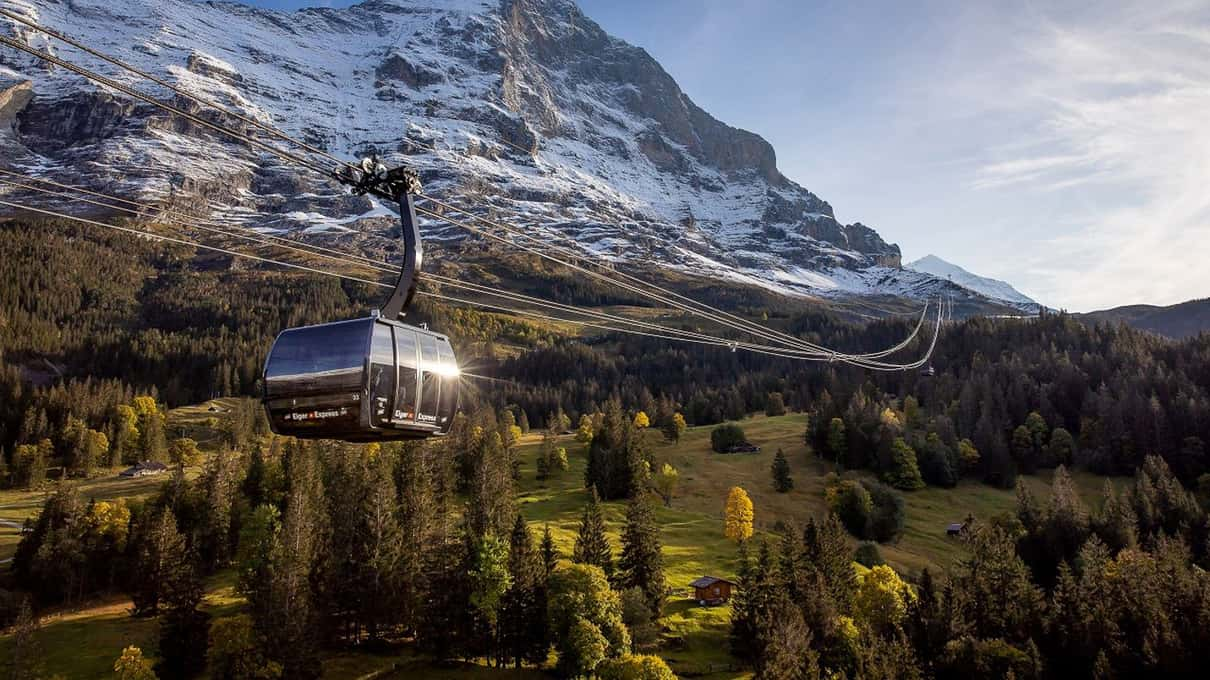
The cable runs toward the Eiger, whose dark rock face is the sight of this ride. In cloud you may see little more than the next tower, so nobody should book the gondola for the photograph alone.
The slow side, past waterfalls and Wengen
The older line has the gentler scenery. It follows the Lauterbrunnen valley, with the Staubbach Falls close to the village, then climbs to Wengen and on to Kleine Scheidegg.
You pay for it in minutes. If your time is short, three quarters of an hour is a large slice of a visit that often lasts two hours at the top.
It also carries the history. Adolf Guyer-Zeller had the idea in 1893, digging began in 1896, and the first trains reached the Jungfraujoch in 1912 through a tunnel of about 7 km (4.3 miles).
Why we would go up fast and come down slowly
The gondola belongs in the first half of the day. You arrive sooner, and the longer ride is left for the afternoon, when a slow train no longer cuts into your visit.
It also means you see both sides of the mountain in one day instead of the same cabin twice. That is our opinion rather than a rule of the railway.
Reverse it only for a reason, such as a hotel in Wengen. The Swiss Travel Pass covers trains to Grindelwald or Wengen, and our page on the Swiss passes explains what changes above those places.
Which route each guided day takes
All of the Jungfraujoch tours from Interlaken with rail tickets included use the gondola at least once. The differences are in the first leg and the way home, so read that line on the booking page.
- Tour 1 at ~$353, our pick, with a coach to Grindelwald Terminal, gondola up, then a train of about 50 minutes down by Wengen to Lauterbrunnen and a coach home
- Tour 2 by public train and gondola, in an order that its two booking pages describe differently
- Tour 3, the private day, with public trains and gondola on the way up and the return by Kleine Scheidegg and Lauterbrunnen
- Tour 4, a guide without the rail ticket, meeting inside Grindelwald Terminal with your seat reservation arranged
- Tour 5 on neither route, because it stays in the two valleys
- Tour 6 by coach from Zurich, then on the same gondola and trains as tour 1 (the two compared)
Tours 2 and 3 use public transport throughout. On tours 1 and 6 a coach covers the road at either end, and everyone still rides the gondola and the cogwheel trains in between.
The small group on public trains
SwissTravelGuide takes 15 people at most from Interlaken Ost at 11:15 am, with every ticket and seat in the price of ~$591. It has only 26 reviews over both sites, and you should ask whether the way back is by Kleine Scheidegg or by gondola.
Its GetYourGuide page lists a 15-minute stop at Kleine Scheidegg and 30 minutes in Lauterbrunnen on the return. Its Viator page has the Eiger Express in both directions, which would leave the valley side out.
When the gondola is not an option
In some Novembers and Aprils the Eiger Express stops for a week or two of maintenance. Everybody then travels by Lauterbrunnen and Kleine Scheidegg, and guided groups are rerouted the same way.
No booking page can promise a running gondola on your date. Expect a slower approach if it stands still, and see how to read the day before you pay when the weather looks doubtful.
Traveling without a guide, enter your whole trip in the railway's fare calculator before you buy. Check that the ticket allows up on one side and down on the other, and whether your date needs the CHF 10 seat reservation (compulsory from May through October).
Doing the loop without a guide
You can make the same loop on your own with a rail ticket bought from the railway. Our train ticket guide covers the fares and the Good Morning ticket, which must start down by 1:17 pm and cannot be combined with passes.
If you would rather have seats and changes arranged, compare the six tours in one table. What waits on top is the same for everyone, so choose the route by the hours you have.
People who only want the two valleys can skip the mountain altogether with tour 5. For everybody else, a guided Jungfraujoch day trip that goes up one side and down the other shows you both in a single day.